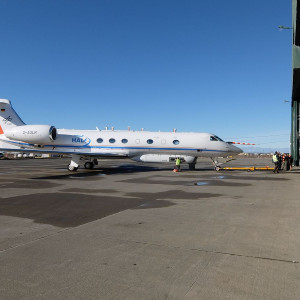
The SouthTRAC aircraft campaign operates the German High Altitude and Long Range Research Aircraft HALO to investigate transport, composition and dynamics of the Southern Hemisphere upper troposphere and lower stratosphere (UTLS).
News and Events
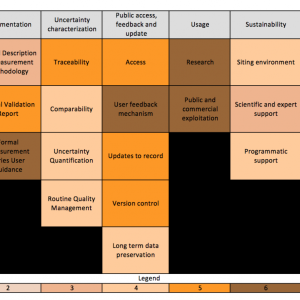
GAIA-CLIM (Gap Analysis for Integrated Atmospheric ECV Climate Monitoring) is a now completed EU H2020 Copernicus pioneering project (2015–2018). It had the aim to identify gaps and establish sound methods to characterize satellite-based observations using ground-based network measurements.
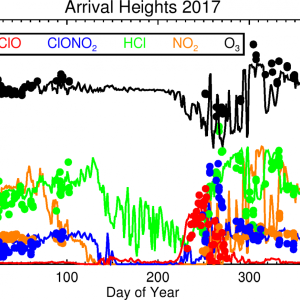
New output for 2018 is available for all stations. All file types from 1985–2017 have been revised — either corrected or improved. The new files have 'MR2V2' in the name to distinguish them as version 2 (V2) files that were created from a simulation integrated with MERRA2.
A measurement system consisting of two array spectroradiometers, a UV-BTS and a VIS-BTS was set up, to achieve a wavelength range from 200 nm to 1050 nm. This system has been compared with the NDACC travelling UV spectroradiometer, which is a double monochromator-based device
About 30 participants gathered to discuss open issues remaining after publishing the SPARC/WMO LOTUS report that was aimed at providing timely input to the 2018 Ozone assessment.
The annual meeting of the international Steering Committee (SC) for NDACC was held 10–14 September 2018 in Geneva, Switzerland at the headquarters of the World Meteorological Organisation (WMO). Geir Braathen of WMO hosted the meeting.
SHADOZ (an NDACC Cooperating Network) data have been re-processed over the past 2–3 years with four papers documenting the activity and evaluating changes in the data and uncertainties as follows.
SHADOZ (Southern Hemisphere ADditional OZonesondes), an NDACC Cooperating Network, is a NASA project to augment and archive balloon-borne ozonesonde launches, and to archive data from tropical and remote operational sites.
Model outputs generated by the Theory and Analysis Working Group are now available as netCDF files for individual stations from 1985–2017. They can be downloaded via the NDACC GMI Model Data Access website. The files are generated from a GMI chemistry transport model (CTM) simulation integrated with MERRA2 reanalysis meteorology.
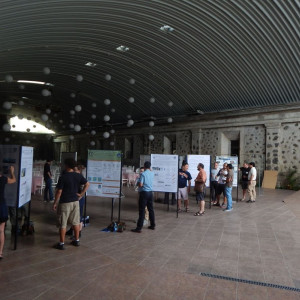
During June 11–15, Universidad Nacional Autonoma de Mexico (UNAM) hosted the 2018 NDACC-IRWG & TCCON Annual Meeting at the Hotel Hacienda Cocoyoc in Cuautla, Mexico.