A recent article by Sergey Khaykin et al. was highlighted in the January 24, 2026 Featured News of the ESA earth online media platform. The Atmospheric Chemistry and Physics (ACP) article shows synergetic observations from the spaceborne lidar ATLID onboard EarthCARE and several suborbital techniques, including NDACC lidars, to characterize the evolution of the 2024 Ruang Volcanic eruption.
Fully operational since July 2024, ATLID has been witness to a significant perturbation of stratospheric aerosol budget following the eruptions of Ruang (Indonesia) in late April 2024. Using ATLID together with limb-viewing satellite instruments (OMPS-LP and SAGE III), the authors quantified the stratospheric aerosol perturbation generated by the Ruang eruption and characterized the global transport of volcanic aerosols. To validate ATLID in the stratosphere, its measurements were compared with observations from four NDACC lidars located at Observatoire du Maïdo (Reunion Island), Observatoire de Haute Provence (France), JPL Table Mountain Facility (California), and Lauder (New Zealand), and with overpass-coordinated balloon-borne measurements carrying the AZOR backscatter sonde.
The intercomparison with the suborbital observations revealed the excellent performance of ATLID in the stratosphere, proving its ability to accurately resolve fine structures in the vertical distribution of stratospheric aerosols. Using various satellite observations, the authors showed that Ruang's eruptive sequence in April 2024 produced vertical columns of volcanic material reaching 25 km altitude, which resulted in a doubling of the tropical stratospheric aerosol abundance for several months. The timing of the eruption (austral fall) and its high-altitude reach led to efficient poleward transport into the Southern extra-tropics during austral winter 2024. By austral fall 2025, the sulphate aerosols from Ruang had spread across the entire Southern hemisphere and were entrained by the 2025 Antarctic polar vortex, facilitating and likely increasing the formation of polar stratospheric clouds.
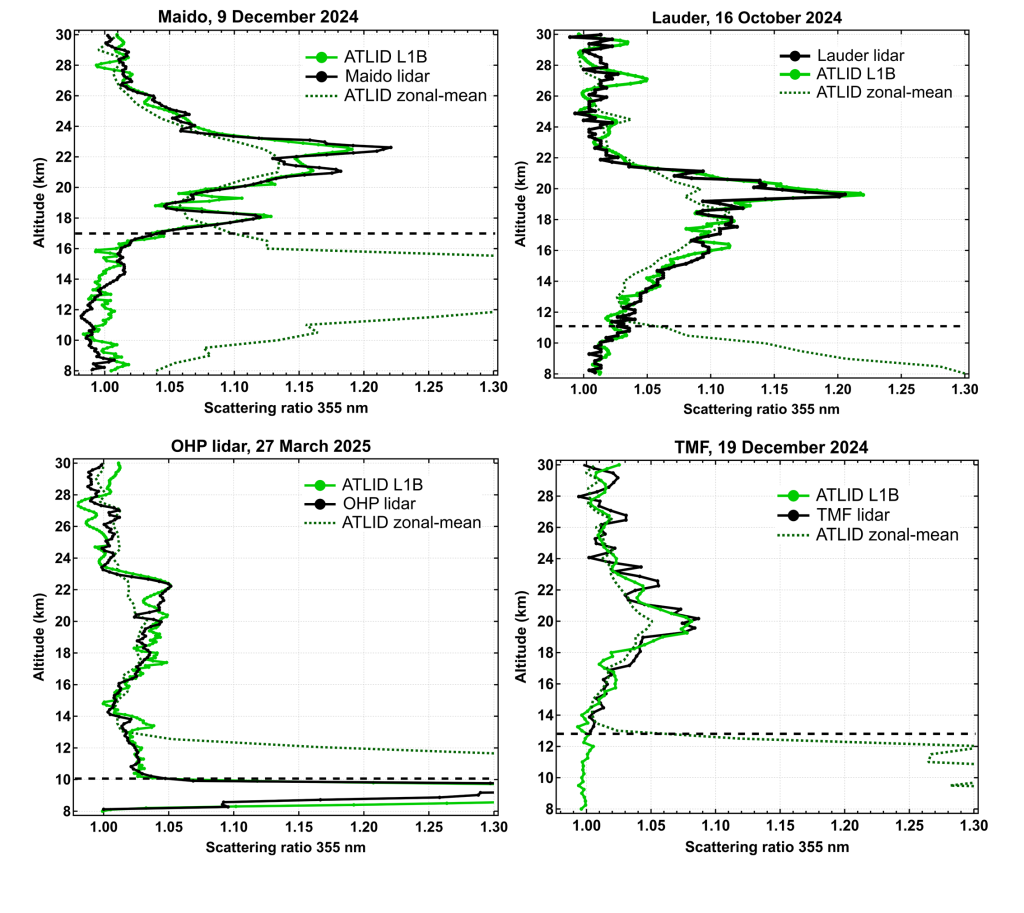
Figure 1: Intercomparison of ATLID with NDACC ground-based lidar and balloon observation of aerosol backscatter at various locations: Maido (French tropical La Reunion island), Lauder (New Zealand), OHP (Haute Provence, France) and TMF (California, USA). Comparison of ATLID with ground-based lidar shows excellent agreement in the stratosphere and ATLID’s capacity to accurately resolve fine structures in aerosol vertical distribution. Image adapted from Figures 4 and 5 in Khaykin et al., 2026. This work is distributed under the Creative Commons Attribution 4.0 License.
The ACP article by Dr. Khaykin, and its highlight in the Featured News of the ESA earth online media platform reminds us once again of the critical role of the “ground-truth”, reference observations of the NDACC network, both for the assessment of long-term changes in atmospheric composition and for the continued validation and intercalibration of newly-launched spaceborne instruments.
ESA online link:
https://earth.esa.int/eogateway/success-story/earthcare-reveals-global-impact-of-mount-ruang-eruption
ACP Article link:
https://doi.org/10.5194/acp-26-607-2026
ACP article Citation:
Khaykin, S., et al. (2026), Global transport of stratospheric aerosol produced by Ruang eruption from EarthCARE ATLID, limb-viewing satellites and ground-based lidar observations, Atmos. Chem. Phys., 26(1), 607-622.