The annual meeting of the international Steering Committee (SC) for NDACC was held 6–10 November 2017 in Boulder, CO, USA at the National Center for Atmospheric Research (NCAR).
News and Events
2016 marks 25 years of successful operations of NDACC for enabling and enhancing global atmospheric research. A comprehensive review article commemorating this anniversary appears in the September–October 2016 issue of NASA’s Earth Observer Newsletter.
The annual meeting of the international Steering Committee (SC) for NDACC was held from October 17 to 21 in Bremen, Germany at the University of Bremen Guesthouse 'Teerhof'. Justus Notholt of the University of Bremen hosted the meeting.
A global network of stations using Dobson and Brewer spectrophotometer have been monitoring the status of the ozone layer during several decades. Corresponding calibration systems have been developed to ensure the good and constant data quality in this network.
AMT published recommendations for the use of standardized vertical resolution and uncertainty for the NDACC ozone and temperature lidars in three special Issues on NDACC's 25th anniversary.
The seventh SPARC science report on 'The Mystery of Carbon Tetrachloride' is now available! The full report helps to answer policy-relevant questions related to the global budget of carbon tetrachloride, an important ozone-depleting substance, closing the gap between emission reported to UNEP's Ozone Secretariat and those estimated from atmospheric observations.
The 8th Implementation and Coordination Meeting (ICM-8) of the GCOS Reference Upper-Air Network (GRUAN) was held in Boulder, CO (25–29 April 2016). GRUAN and NDACC have had a long-standing collaboration (dating back to ICM-1 in 2009) that was further formalized by both GRUAN and NDACC becoming Cooperating Networks.
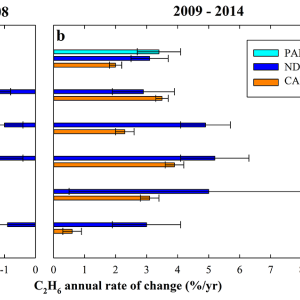
Until recently, the abundance of atmospheric ethane (C2H6) has been declining, primarily due to reduced fugitive emissions from oil and gas activities and to the successful implementation of pollution abatement measures.
Tropospheric ozone is an important greenhouse gas and an air pollutant impacting human health and vegetation. Recent studies highlight the importance of increasing the number of tropospheric ozone profiling stations and long-term measurements to fully understand its sources and variability.
Like carbon dioxide, methane is one of the most important greenhouse gases. After a period of stagnation around 2000, atmospheric methane concentrations started to rise again in 2007. So far, the causes have been unknown.