Contrary to the Antarctic, where ozone recovery has been observed for about a decade, the detection of positive ozone trends in the Arctic remains challenging due to the higher natural variability of ozone in that region.
In this study we have used long-term ozone NDACC data from Fourier transform infrared spectrometers (FTIR) and ozonesondes, as well as WOUDC data from Dobson and Brewer spectrophotometers, amounting in total to 17 different stations spread over the 60 to 90 degrees North latitude band. By merging these records, we have obtained regional long-term trends (2000–2024) for total, stratospheric and tropospheric ozone.
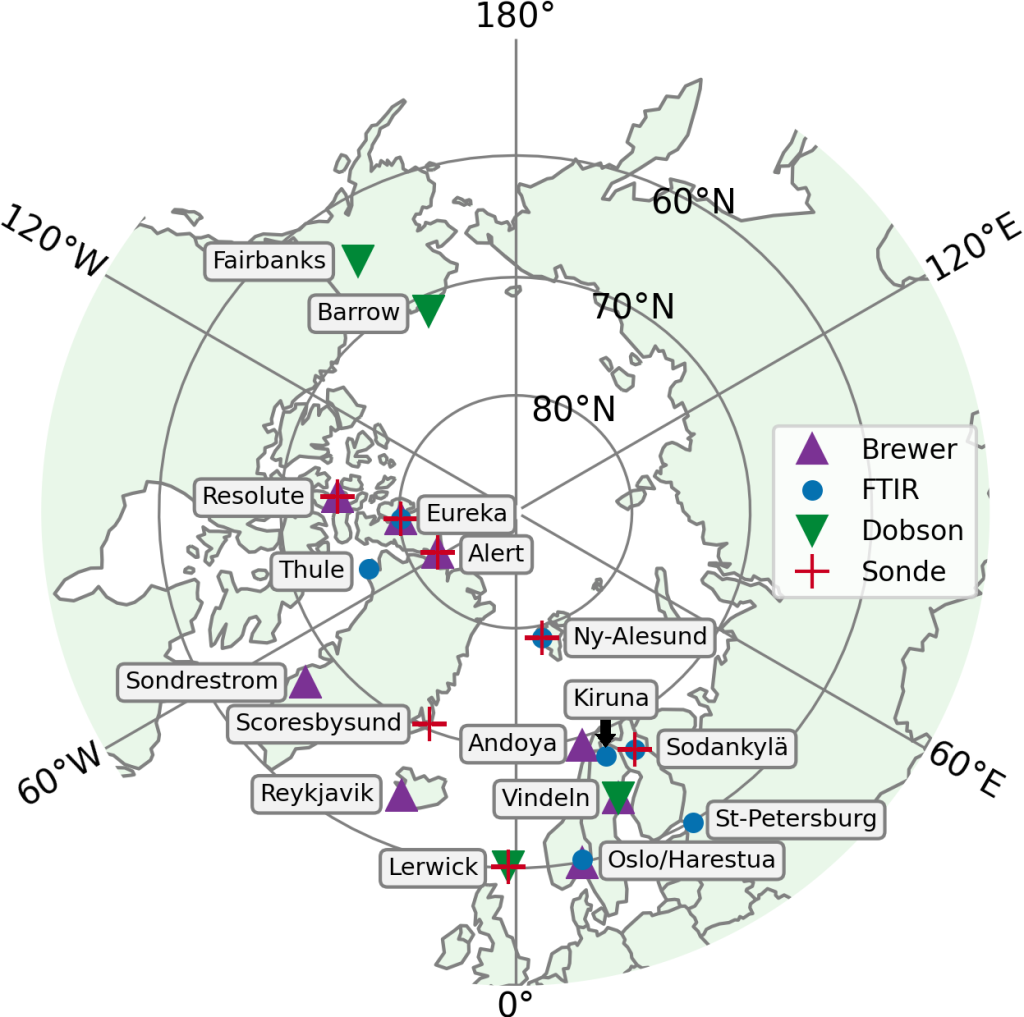
Figure 1: Network of the NDACC and WOUDC ground based stations with ozone data sets used in this work.
In the first step of this work, we have cross-compared all the ground-based measurements to two satellite data sets (MEGRIDOP and IASI-CDR). This enabled us to detect drifts in ground-based data sets we further excluded from our study. The second step consisted in defining the extent of regions within which these ground based ozone data sets were highly correlated and could be merged together consistently. This was done using a representativeness study based on CAMS re-analysis ozone profile data. We therefore obtained region representative trends with reduced uncertainties by combining data sets from different instruments and stations. Finally, we could calculate annual and seasonal trends with a multiple linear regression technique which involves a set of proxies representing physical processes with an influence on the natural ozone variability.
Our annual 2000-2024 trends indicate increasing total ozone over the Arctic, and are statistically significant over Canada and Reykjavik (+2.1 % per decade) and North-West Europe (Harestua and Lerwick, +0.7 % per decade). Our study also establishes the recovery of ozone over Canada in the mid-stratosphere (+2.0 % per decade) and over the North Pole region (Canada and Ny-Ålesund) in the upper stratosphere (+2.1 % per decade to +3.8 % per decade). By analyzing the sensitivity of the ozone trends to the proxies, we could attribute a slow down of the expected ozone recovery, especially in the lower stratosphere, to stratospheric cooling (−0.6 % per decade) and to the increase of volume of polar stratospheric clouds (−0.8 % per decade).
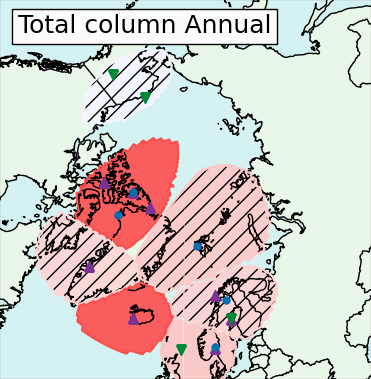
Figure 2: Annual total column trends for all representative regions in percent per decade over the full 2000-2024 period.
More details are given in https://dora.aeronomie.be/
The paper is available at: Jonas, C., Vigouroux, C., Langerock, B., Björklund, R., Boynard, A., Carlund, T., De Mazière, M., Effertz, P., Errera, Q., Frey, M. M., Granville, J., Hannigan, J. W., Keppens, A., Jepsen, N., Kivi, R., Lyall, N., Palm, M., Prignon, M., Sofieva, V. F., Strong, K., Svendby, T., Tarasick, D., Thölix, L., Van Malderen, R., Virolainen, Y., von Löwis, S., and Zhao, X.: Detection of ozone recovery in the Arctic from ground-based measurements, Atmos. Chem. Phys., 26, 8089–8124, https://doi.org/10.5194/acp-26-8089-2026, 2026.