This introduction to the special issue "Achievements and perspectives of the Network for the Detection of Atmospheric Composition Change after 35 years of operation” provides an overview of important research findings achieved under the NDACC objectives. The future of NDACC is discussed in the light of the evolution of the scientific questions, evolving collaborations with partners and Cooperating Networks, and the current landscape of gaps in satellite and ground-based observations.
News and Events for 06/2026
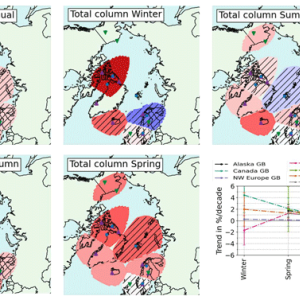
Jonas et al. studied the evolution of ozone in the Arctic over the 2000–2024 period in the stratosphere (about 10 to 50 km) to assess the expected recovery of the ozone layer following the diminution of ozone-depleting substances. They merge ground-based data sets within spatially coherent regions to reduce uncertainties and obtain positive trends for the total column everywhere in the Arctic and for the middle and upper stratosphere over Canada, but no significant trends in the lower stratosphere.