The Fourier-transform infrared spectrometer (FTS) installed at the Onsala Space Observatory, located close to Gothenburg, Sweden (57.4° N, 11.93° E), has been accepted into the NDACC network this year. The Onsala Space Observatory was already part of NDACC through a microwave radiometer providing water vapour measurements since 2002.
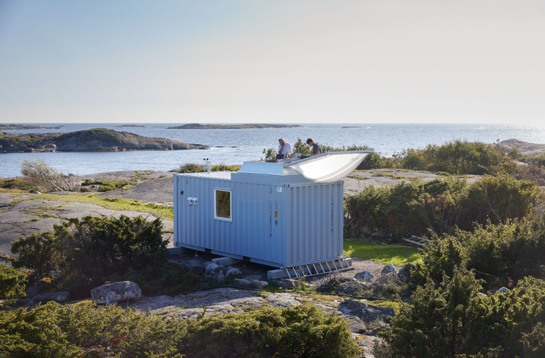
Figure 1: The container housing the FTS at the Onsala Space Observatory, Sweden.
The FTS was installed in summer 2023 and has been routinely operated since September 2023. It is equipped with the NDACC standard mid-infrared detectors (InSb and MCT) and seven optical filters, allowing measurements of the spectral features of all infrared NDACC species (e.g., ozone, hydrogen chloride, hydrogen fluoride, carbon monoxide, …). It is also equipped with an additional InSb detector and an InGaAs detector to retrieve column-averaged mole fractions of several carbon species, including carbon dioxide and methane.
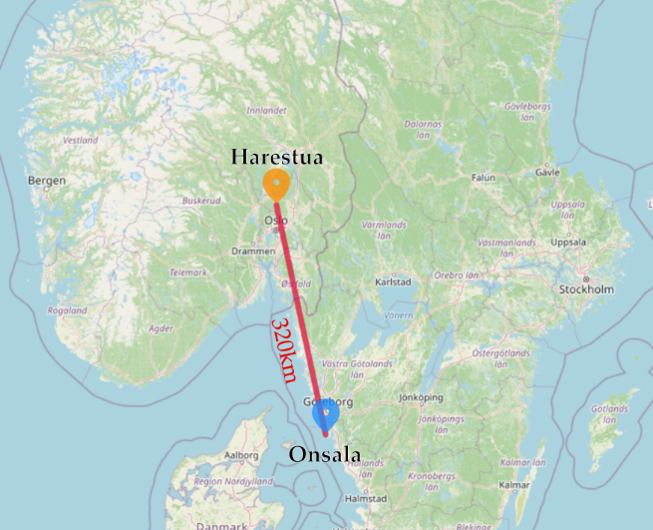
Figure 2: Locations of the two infrared stations operated by Chalmers University of Technology.
The instrument is operated by Chalmers University of Technology, which also operates the NDACC Harestua FTS (1994–present). The ongoing overlapping measurements from the two stations since 2023 will help assess whether the Onsala measurements could be used to extend the Harestua time series in the event that FTS measurements at Harestua have to be discontinued due to a major technical issue and a lack of funding to replace the instrument (see Figure 3).
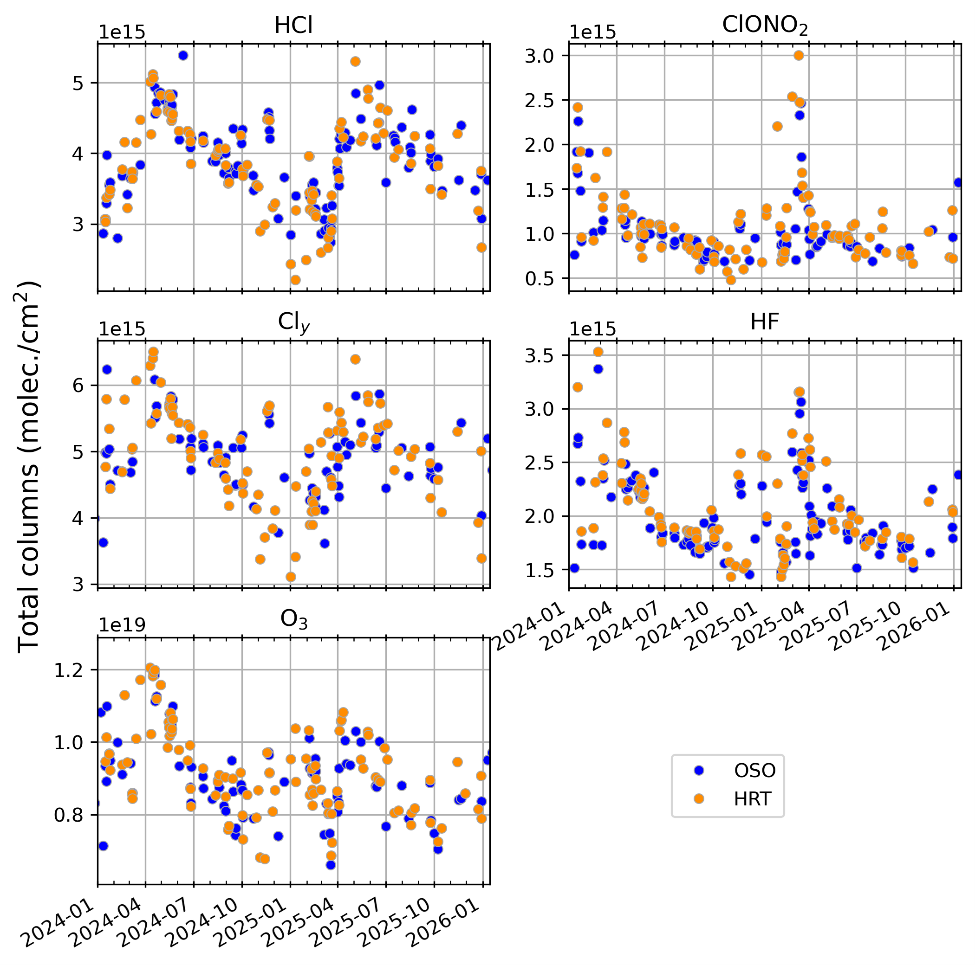
Figure 3: Comparison of HCl, ClONO₂, Cly, HF, and O₃ time series measured at Onsala (OSO, blue) and Harestua (HRT, orange).
The FTS stations of Onsala and Harestua are supported by the Swedish EPA and internally by Chalmers University of Technology. The operations will also be supported by ACTRIS Sweden from 2027.
More information on the Onsala Space Observatory here: https:/chalmers.se/en/infrastructure/oso/
Instrument PI: Professor Johan Mellqvist, Geoscience and remote sensing, Dept. of Environmental and Energy Sciences, Chalmers University of Technology
Co-PI: Maxime Prignon, Geoscience and remote sensing, Dept. of Environmental and Energy Sciences, Chalmers University of Technology