The Small Mobile Ozone Lidar with eXtended capability (SMOL-X) is a compact, autonomous ozone differential absorption lidar developed at NASA Jet Propulsion Laboratory in support of the NASA Upper Atmospheric Composition Observations Program. SMOL-X was designed to measure profiles of ozone in the troposphere and stratosphere up to 35-40 km, as well as stratospheric temperature, polar stratospheric clouds (PSCs) and aerosols (Leblanc et al., 2026, in preparation).
The SMOL-X instrument design is based on that of the SMOL instrument (Chouza et al., AMT, 2025), but with additional capabilities, including a larger laser energy per pulse, additional emission at 532 nm (for PSCs and temperature), a larger telescope for the high intensity channels, and additional receiving channels to accommodate the ozone-rich stratosphere. After a successful validation period in early 2025 at the JPL Table Mountain, California, and then at Lauder, New Zealand in late 2025, SMOL-X was successfully deployed at Scott Base, Antarctica (166.76ºE, 77.85ºS) in February 2026. The instrument setup by Drs. Chouza (JPL) and Querel (ESNZ) went smoothly and ozone profiles could be measured shortly after installation. Figure 1 illustrates SMOL-X capability under twilight conditions.
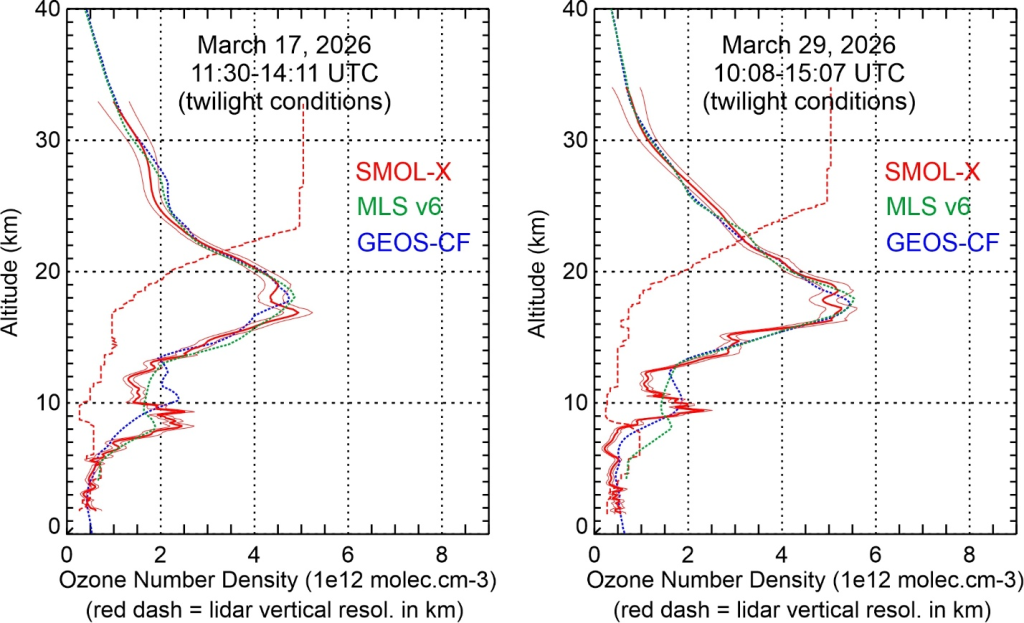
Figure 1: Two of the nine ozone profiles measured by SMOL-X at Scott Base, Antarctica in its early stage of deployment. Red solid curves: SMOL-X ozone number density and +/-1-sigma uncertainty. Dash red curve: vertical resolution. SMOL-X maximum altitude range is expected to reach 40 km in the next few months, when darker conditions prevail.
SMOL-X has operated nominally since its installation in February, and by August 10, was able to detect the first sign of ozone depletion. The 2026 Antarctic winter saw the development of a large area of polar stratospheric clouds (PSCs) inside the vortex, facilitating ozone destruction through heterogeneous chemistry. As of mid-September 2026, the Antarctic ozone hole area almost reached the all-time (1979-present) maximum (26 million km2 in 2026 for an all-time max of 27 million km2 in mid-September).
Figure 2 shows two ozone profiles (+/- 1s uncertainty) measured by the JPL SMOL-X lidar instrument deployed at Scott Base. The red profile (Aug. 16) is representative of mid-winter ozone accumulation inside the polar vortex. The blue profile (Sept 5) shows a depleted ozone profile resulting from photochemical destruction taking place in late winter/early spring (sunlit, cold conditions). The figure also shows the simultaneous and co-located ozone forecast from the NASA GMAO GEOS-CF model (orange and cyan profiles). Agreement between the model and the lidar observations is remarkable on both days.
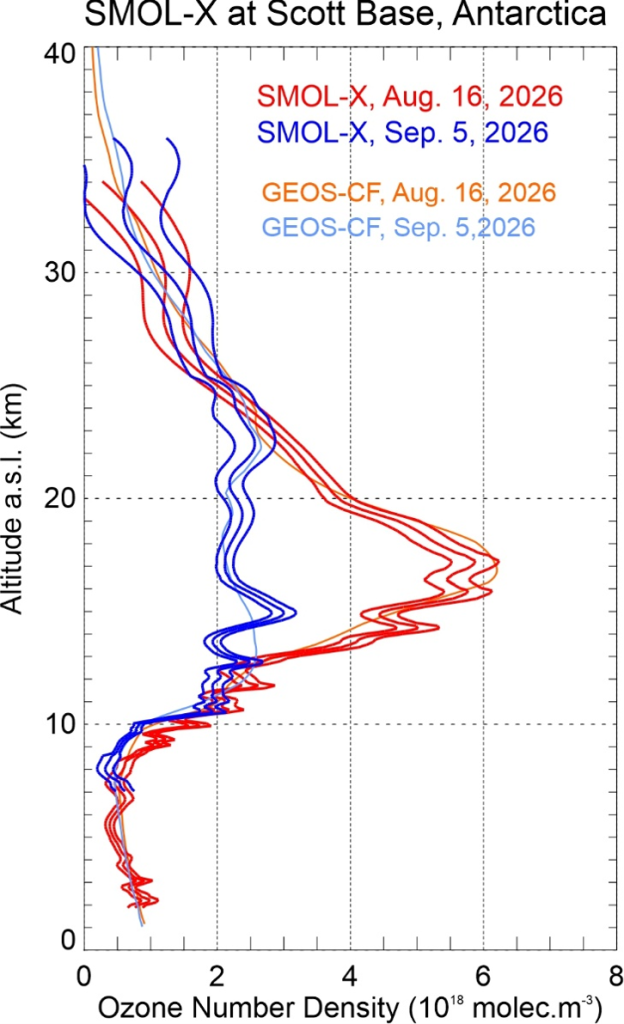
Figure 2: Ozone profiles (+/- 1s uncertainty) measured on Aug. 16 (red) and Sept. 5, 2026 (blue) by the JPL SMOL-X lidar instrument deployed at Scott Base, Antarctica. The simultaneous, co-located GOES-CF forecast profiles are shown in cyan and orange.
Routine monitoring of ozone variability in Antarctica is essential to identify dynamical and photochemical processes leading to ozone depletion, and to help track stratospheric ozone long-term recovery. This is the first deployment of a differential absorption lidar in several decades in the Antarctic. This deployment at Scott Base was made possible thanks to a close collaboration between NASA and Earth Sciences New Zealand, with logistical support provided by AntarcticaNZ. SMOL-X is the only ozone lidar currently deployed in Antarctica. This new class of affordable, automated, portable ozone lidars constitutes an important new capability for atmospheric composition observation networks such as NDACC. It is planned to build and deploy several additional SMOL-X instruments at carefully-selected NDACC sites, where science needs are found to be of highest priority (e.g., Arctic sites and tropical sites).
References:
Chouza, F., et al. (2025), The Small Mobile Ozone Lidar (SMOL): instrument description and first results, Atmos. Meas. Tech., 18(2), 405-419.
Leblanc, T. et al., The Small Mobile Ozone Lidar with eXtended Capabilities (SMOL-X): A new portable stratospheric ozone lidar Instrument for use within the Network for the Detection of Atmospheric Composition Change (NDACC), Manuscript in preparation, 2026.
The research was carried out at the Jet Propulsion Laboratory, California Institute of Technology, under a contract with the National Aeronautics and Space Administration (80NM0018D0004)
© 2026 California Institute of Technology, Government sponsorship acknowledged.